

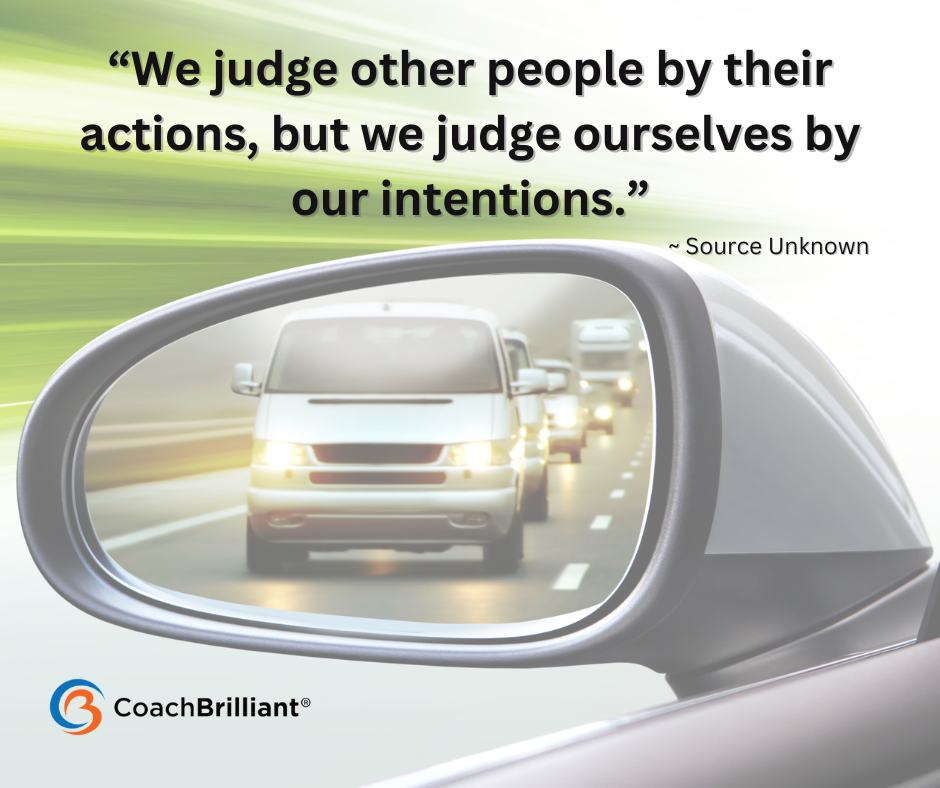
 Have you ever had a situation where you’ve had good intentions but the other person misunderstood you? Or perhaps you’ve totally misread someone else because you were judging them by their actions?
This happened to one of my coach clients recently.
We set an intention and move forward toward it… Our motivations drive our behavior.
The challenge is that without knowing our intentions, other people will make assumptions and judge us on our behavior (what we do, say or how we act).
If we don’t make our intentions clear, then we’ll be judged on our actions and this can lead to misunderstandings, confusion, and conflict.
Especially if our actions don’t match our intentions.
Let me give you an example…
SCENARIO ONE
Imagine that you are driving down the Interstate (or Motorway in the UK) and you hear the wailing sound of a siren.
Looking in the rearview mirror you see an ambulance speeding up in the distance behind you. The driving style of the ambulance is urgent, purposeful, and fast.
The purpose of the ambulance is known to us. We understand this driving style is the best way of urgently getting to someone in need. Perhaps there is a traffic collision on the road ahead and they are responding as quickly as possible.
You instantly slow down and pull to the side of the road to allow it to pass… even if it cuts you up in the slow lane, but it’s okay, you let it pass.
WHY?
Because you know its intention…
We know the purpose of the vehicle (ambulance) is to provide help and support to others in need.
This is a great way to separate Intention (Vehicle) from behavior (driving style).
Let’s now consider a different situation…
SCENARIO TWO
You are driving down the same Interstate (Motorway) and a white van comes up fast behind you flashing its lights, honking its horn, and trying to cut you up in the slow lane.
Is that ok?
How might you react to it?
You might speed up or touch your brakes and slow down to not let it pass.
You might try to block it, becoming more aggressive in your response.
You might even use physical gestures toward the driver! (I’m not judging you here at all 🙂)
You might let it by and then feel frustrated and angry for the next hour, reliving the experience in a continuous loop and imagining different all the different ways you should have dealt with it while using an abundance of words to describe the driver!
WHY do we respond differently to this vehicle?
Because its purpose is not known, so we make assumptions.
Yes, the driver might just be a jerk… Also, the driver might be rushing to the hospital because a member of the family was in an accident and he or she is desperately trying to get there.
I have been that driver – driving fast and purposefully…
The day my Dad died, I lived 270 miles away from the hospital. When I suddenly got the call he was dying, I had to drive from the South of England to the North as fast as I could. I’ve never driven so fast in my life…
Driven by my intention and the motivation to be there for him, I was literally praying for people to move out of the way as I was driving. Somehow I made it in time – I was grateful to arrive and be with my Dad for a few hours before he passed.
In the case of the white van we don’t know WHY the person was driving fast, we only have his/her driving behavior to go on. It’s easy to make a judgment based on their behavior alone and make assumptions.
If we unconsciously get triggered, we react to that behavior.
Behavior breeds behavior…
The truth is that we judge other people by their actions, but we judge ourselves by our intentions.
Learn to understand WHY people behave the way they do
If we can understand the reason WHY people behave the way they do, then we can make better judgments of their behavior and possibly prevent us from making some errors of judgment in our interactions and relationships with others.
Don’t just assume that you know their intention or motive for their behavior – you don’t know what’s going on inside unless you ask.
This is essential to understand if you are coaching others because you’re only seeing part of the full picture of what is going on…
Looking at what is behind the behavior will give you insights into your client’s emotions and feelings. Someone might be scared, angry, or anxious and the behavior they are demonstrating is an unconscious coping strategy. Their way of protecting themselves.
We tend to look for mirror images of what is acceptable behavior for ourselves in others. If someone reacts differently, then we can make assumptions and judge them. It’s important to recognize that we all have different world views and others may behave differently to us in a situation.
Whatever our worldview we are likely to perceive and judge people in a different way.
We always have a choice in how we perceive, judge, and behave toward others.
It is important to understand that our own self-perception is based on our internal motives and intention…
In other words: What we are internally focused on doing…
Whereas other people’s perception of us is based on our behaviors: what we do, what we say, or how we act.
In other words: What we are demonstrating to others…
Both views of the same situation are seen as the truth from each different viewpoint:
- Through YOUR lens of the world.
- Through the OTHER PERSON’S lens of the world.
Do your actions match your intentions?
If your actions don’t match your intention then there is a corruption of the message from what you are believing to what others are perceiving!
This can lead to mixed messages, misunderstandings, and assumptions.
Here are some ways to align your actions with your intentions.
- Understand we judge others by their actions, and ourselves by our intentions. Our actions and intentions are not always congruent and give out mixed messages which can be received with indifference compliance and misunderstanding. Even though an intention is good… this makes us defensive, protective, and less open to the truth.
- Become an observer of YOU – Learn to be curious, open, and vulnerable to exploring what it is like being on the receiving end of you. This is such a powerful way to learn. Step back and see yourself as a Work-In-Progress. Giving yourself permission to not have to get things 100% right all the time!
- Authenticity begins with empathy for ourselves and for others. Communicate your intention.
Do your actions match your intentions?
This is a great question to explore with your coaching clients.