


If you had the opportunity to go deep into the woods to reconnect with Nature, lose all concept of time, and co-exist among wild Black Bears for a few days and nights would you do it?
This is EXACTLY what I did recently!
As you read this you might be asking yourself…
But aren’t black bears aggressive?
Isn’t that dangerous? – Don’t they have big teeth and claws?
Wild animals are so unpredictable, aren’t they?
…And you wouldn’t be crazy asking these questions because most of us have been conditioned to think this way about bears (and other wildlife including wolves.). Through generations, we have heard stories and become fearful of them.
Bears have been unfairly demonized for centuries.
Myths and stories have led to exaggeration of the perception of danger. This has never worked out well for the Bears. It has led to trapping, shooting, and their eradication using bounties, and even poisoning.
People believe and sensationalize the stories and then fear breeds fear…
We all love a good story right?!
Here are a few of the common myths about black bears that Dr. Lynn Rogers’ research has disproved:
- Bears attack if they sense fear ❌
- Black bears that have lost their fear of people are more likely to attack ❌
- Mother black bears are likely to attack ❌
- Black bears are stinky (they don’t smell at all!) ❌
- Black bears don’t feel pain like people do ❌
You just have to look back through our history to see the pattern: if we perceive something competes with us for food, habitat, greed, etc., we tend to destroy it often without question. We don’t stop to gather a deeper understanding of the situation or look at the bigger impact that this destruction might have on the ecology.
We are fear-based beings and are deeply programmed for fight and flight.
Today humans also have power, control, and the tools to destroy anything they perceive to be a threat!
The International Union for Conservation of Nature (IUCN) currently lists six out of eight species of bear around the world as vulnerable or endangered:
“Only the brown bear (grizzly) and the American black bear are considered species of “least concern.” The other six species are threatened due to hunting by people for various reasons and reduction in their habitat.”
There is a huge need for accurate information and education about bears.
Why?
Because people’s understanding of bears and their attitudes towards them will determine the future of bear populations and habitats around the world.
Thank goodness for Dr. Lynn Rogers and his research!
I recently had the privilege to attend a Black Bear Field Study Course at the Wildlife Research Institute in Ely Minnesota with North American Bear Center founder and principal biologist, Dr. Lynn Rogers, Ph.D.
Lynn Rogers has spent 50+ years studying wildlife behavior and ecology specializing in bears and has proved black bears are not the fearsome animals that some people think.
He combined Jane Goodall’s trust-based research (Goodall 1971) ) with modern technology to challenge every fear-based person and state wildlife agency’s “killer bear” concept in solid ways, proving that bears and humans can co-exist peaceably.
Over many years researchers accompanied bears for 24 hours a day in the woods for data collection. By walking with the wild bears they studied their behavior, ecology, hibernation, body language, social organization, physiology, vocalizations, and human and bear relationships.
I knew I was in very safe and capable hands (and paws! 🐻)
What this taught me about human behavior, fear, and trust
If you’ve read this far, you may be asking: What has this got to do with coaching?
All my life I’ve been passionate about helping people learn and grow. My professional career has been dedicated to human behavioral development.
I’ve often worked with people who struggle to understand each other because of differences in our personalities, working styles, and cultures. I’ve helped them to understand and recognize the differences and to change their perception and behavior to get positive outcomes/results.
We are judged in life by our actions, not our intentions. If you don’t communicate your intentions then you are judged on your demonstrated behavior. In other words, how you show up is who you are to the other person.
Fortunately, humans have evolved the capacity for verbal communication.
If we consciously develop our communication skills we can talk to each other, hopefully recognize and understand our differences and resolve any conflict.
For human-to-human interactions, this (mostly) works well…
However, it’s different when you are trying to communicate with other beings (animals) on this planet…
Black Bears do not talk!
Nor do any other animal that I’m aware of…
You can’t ask a bear what he/she is thinking or feeling. You have to learn how to recognize and understand their demonstrated behavior.
For example…
When a bear bluff-charges (false charges) and lunges forward, most people perceive this as aggressive behavior and are fearful it might lead to an attack. This is often misunderstood as an attack!
The truth is the bear is anxious and frightened and is just telling you to back off, and not to come any closer! Dr. Rogers’ research proves that bears never attack in these instances (unless of course, you then decide to provoke it).
Humans often expect animals to behave like humans so we make assumptions and misunderstand what is going on. With Pets, it’s usually the owner at fault and not the animal. The dog or cat is just trying to be… a dog or cat!
You’ve seen people dressing their pet dogs in clothes on FB right?! We sometimes like to believe they are furry humans and they understand what we are saying.
Animals do communicate with us all the time but in different ways.
We just have to slow down and be willing to pay attention and learn what their behavior means. Pioneers like Dr. Lynn Rogers have made this easier for us because of sharing their extensive research and experience.
There is a whole new world of behavioral predictable patterns to learn beyond human behavior.
This is something that I believe our ancestors were more attuned to before we turned our world into concrete boxes. I also believe that attuning to this can help us to become better humans.
Understanding animal behavior is fascinating. It’s like learning a new language. When you can’t communicate using the spoken word, it opens up all your senses to new ways of developing understanding and being beyond words.
It was refreshing to let go of words and learn how to communicate from a much deeper place. Observing, reading body language, and responding to it from an intuitive perspective.
My first encounter with a Black Bear
Arriving at the Wildlife Institute was like I’d been transported to a different world…
My first close wild bear encounter was with Ty (see the photo below). At the time of my visit Ty weighed 574lbs and was 14 years old. A gracious, true gentleman.
I got to observe him in his pure beary-ness.
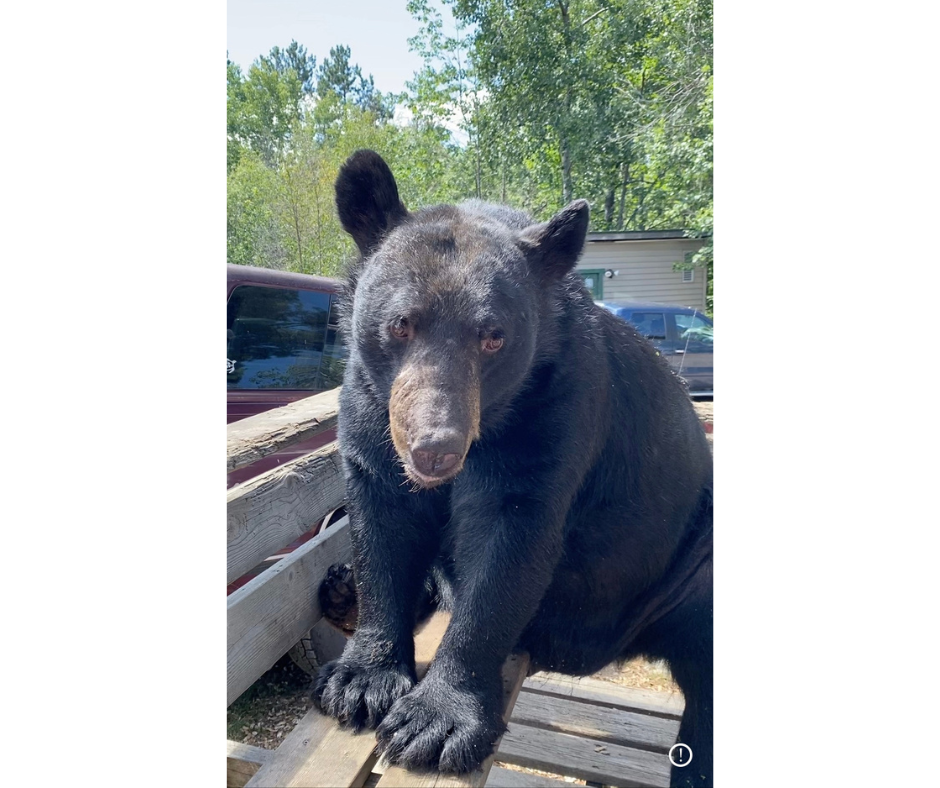
Strangely, I wasn’t afraid – I trusted this guy.
Trust is born through curiosity and experience. This helps us to develop a deeper understanding.
I realized he was open to trusting me as much as I was open to trusting him.
In that moment, time stopped. As I looked into his eyes I felt a deep connection to him. It was the essence of pure love. I was closer to the truth than anything I’d ever felt in my life before. I felt in tune with all of life.
Nature has wisdom beyond words.
Over time, as adults we lose the natural curiosity we had as a child and Nature fades into the background of our busy lives. We no longer see the bugs, animals, flowers, birds, or trees around us. They no longer feel like our friends and we become separate.
We focus our selfish attention on our own importance, the needs of our ego – what we have to do and achieve. We are all consumed by the deafening noise of our human existence and our own thoughts.
Meeting Ty reconnected me to Nature’s silent message – The magic of curiosity and the ability to deeply feel.
I gave him no reason to fear me and he gave me no reason to fear him. We were co-existing in the same space and time, both fully present in the moment. Human to Bear – Bear to Human.
It was that simple.
A few bear facts:
Bears are naturally curious, intelligent, and mostly shy…
They are more scared of you than you are of them. In the wild, when they see you they will just stand still, watch and observe (you may have witnessed this). I have experienced this many times.
Their natural order is freeze, then flight and they will only fight as a very last resort if they feel threatened and perceive their life is in danger.
According to the National Center for Health Statistics, Dept of Justice, U.S. Census Bureau for each person killed by a Black Bear:
2 people are killed by grizzly bears.
13 people are killed by snakes.
45 people are killed by dogs.
120 people are killed by bees or hornets.
249 people are killed by lightning.
20,000 people are murdered in the US.
So attacks are very rare.
Excessive warnings about attacks create unnecessary fear especially when news and radio stations love a great story (This is happening just now in Asheville, NC 🙁).
Dr. Rogers’ research aims to provide balanced and factual information through actual video footage and research data.
The field study course I attended provided daily up-close observation of wild bears to learn their vocalizations, body language, social organization, ecology, and learn how people can better coexist with bears.
Returning to Asheville I am confronted by the reality that our NC bears will be lured to bait sites in December – January when hunting season begins. It begins in November around the Wildlife Research Center in Minnesota for bears like Ty.
As a ‘Lover of Bears’ I feel this grief on a visceral level.
I hold them all in my heart and pray they all stay safe.
To have encountered so many wild bears in a place where humans choose to co-exist with bears was a revelation for me. I have never felt such peace. It felt like I was coming home to Nature’s truth!
This extraordinary experience has changed me at such a deep level. I’m still processing it all.
Nature’s silent message is always there don’t let it get ignored and drowned out by all the external noise in our concrete man-made lives. Open your heart, quiet your mind, and be curious to your true nature.
There’s a whole different world out there…
You can learn more about these amazing animals and Dr. Lynn Rogers’ extensive work here: https://bear.org/visit-us/about-us/our-founder/
Baiting the bears is inhumane 😢Thanks for your input. We will be visiting The Smoky mountains soon. We always see bears. But we have learned through the years to respect them. 😊❤️🐻
Thanks so much, Carolyn. It breaks my heart to know that this happens. Enjoy your trip to the Smoky Mountains.
Thank you for sharing this. I too feel the same way (visceral and intuitive) and wish I could partake in such a study. It pains me so deeply that these beings are hunted….This needs to stop now. It’s cruel, and there is no reason other than blood, lust, greed, ignorance, and sport. Why can’t we ban together to get a Nationwide Ban on hunting of all Bears?. Animals control their own population.
Thanks so much for this, Janice. The study was so insightful. Maybe you might get a chance to do this in 2024! I wish everyone who coexists with bears could go on this field study course, it would make a huge difference to people’s understanding and respect for our precious bears and other wildlife too.
I have a friend who I met at the course who was able to ban the bear hunt in Florida… We have to keep educating and talking about bears. I believe, like you, that animals control their own population. Research has proven this and what happens when we try to intervene and disturb the balance in the ecology.
It breaks my heart that many humans are ignorant 🙁
Hi I’m Finney, I came across this article researching for my high school AP research question. I’m making it in relation to human history with bears because they are my favorite animal of all time. It’s my dream to be able to do something like this and research bears in person to collect research for my topic.
I’m glad this was helpful! 🙂