


If you’re a coach, I’m sure you’ve occasionally experienced a situation where your client may have said something or acted in a way that triggered you, and you unconsciously instantly reacted in the moment. After the session you regretted how you handled the situation.
This happened to one of my coach-clients last week. Ben came to our coaching session with a great question:
‘How do I avoid becoming reactive during a coaching call?’
Ben’s nervous system was already on alert when he had read his client’s pre-coaching form. He was triggered by a comment she’d written about something not working. He started to take the comment personally. Then during the session his client said something that triggered him and Ben reacted in the moment by giving her some ‘coaching feedback.’ His client became confused, and defensive and the coaching session ended awkwardly.
Ben felt ashamed of how he had reacted, he’d misread the coaching form and knew he should have handled it better.
MYTH – Coaches are immune from emotional vulnerability
Coaching is no small undertaking… it requires our full attention and it’s easy to become momentarily distracted by our own intruding thoughts and emotions, as we are listening to our clients. Unconsciously our attention can get pulled away from the present moment.
We can make assumptions and pre-judge how a session is going to play out before we even get on the call with the client.
We are often aware of the impact we have on our clients but can be unaware of the emotional impact that our clients can have on us during a coaching session.
Coaches are human too, and we can unconsciously become reactive when something is said or done that drives us internally and automatically triggers an emotional response.
If we don’t know ourselves well, then we can unconsciously react rather than respond in a situation, and this is totally unplanned and often unhelpful. Our reaction could change the energy of the session. Your client might react and shut down, even become defensive, as their pattern begins to dance with your pattern. Personalities take over and Ego runs the show.
As coaches, we can sometimes be deluded into believing that somehow during the session we are magically immune from any emotional vulnerability. After all, the conversation is ALL about your client right?!
Many of us forget that our energy influences the other person but we are also influenced by the other person’s energy in the conversation. It’s an interactive flow that affects both of us.
As the coach, you might react sarcastically, passive-aggressively, or become critical, even being direct and disguising your comments as ‘coaching feedback.’ Your client may become confused, by your unconscious behavior as it’s sending a mixed message…
For example, your body language may be demonstrating that you are irritated or defensive, yet your tone of voice is calm and non-aggressive (as you try to hold your irritation inwards). Remember your mind and body are connected… and what you are thinking might not leak out in your words or tone but it will in your body language! Especially if you aren’t aware of it happening!
How to avoid becoming reactive during a coaching session.
If you want your clients to get the most from their coaching sessions with you then, their presence matters. But your presence matters too. Your presence begins as you are preparing for the session…
Our own patterns often run unconsciously in the background of our daily lives, and when we show up to coach, they are busy working as you see that person’s name on your coaching schedule for the day… Just the name might invoke a negative reaction for you! (anxiety, concern, irritation…) Before you know it you are up in your thoughts and in your story fantasizing about what might happen during this call or something that happened last time, that irritated you.
You are already predicting what might happen during the session and creating a story around it. Your nervous system is becoming elevated and you’re getting triggered.
When this happens you’re not ready to coach…
Shaking it off…
My dog Ogden is a great teacher! Anytime that a situation triggers him and he gets defensive or anxious… he quickly shakes it off. Literally – he walks a few steps and shakes from nose to tail. This shifts his energy and changes his state. The shaking helps to release muscular tension, excess adrenaline, and calms his nervous system back to its neutral state.
Now I’m not saying you should try shaking like Ogden! (But if you’re curious check out Dr Peter Levine’s work – In his book “Waking the Tiger: Healing Trauma,” He talks about how animals shake to release tension and stress. Just like Ogden!)
How to return to neutral
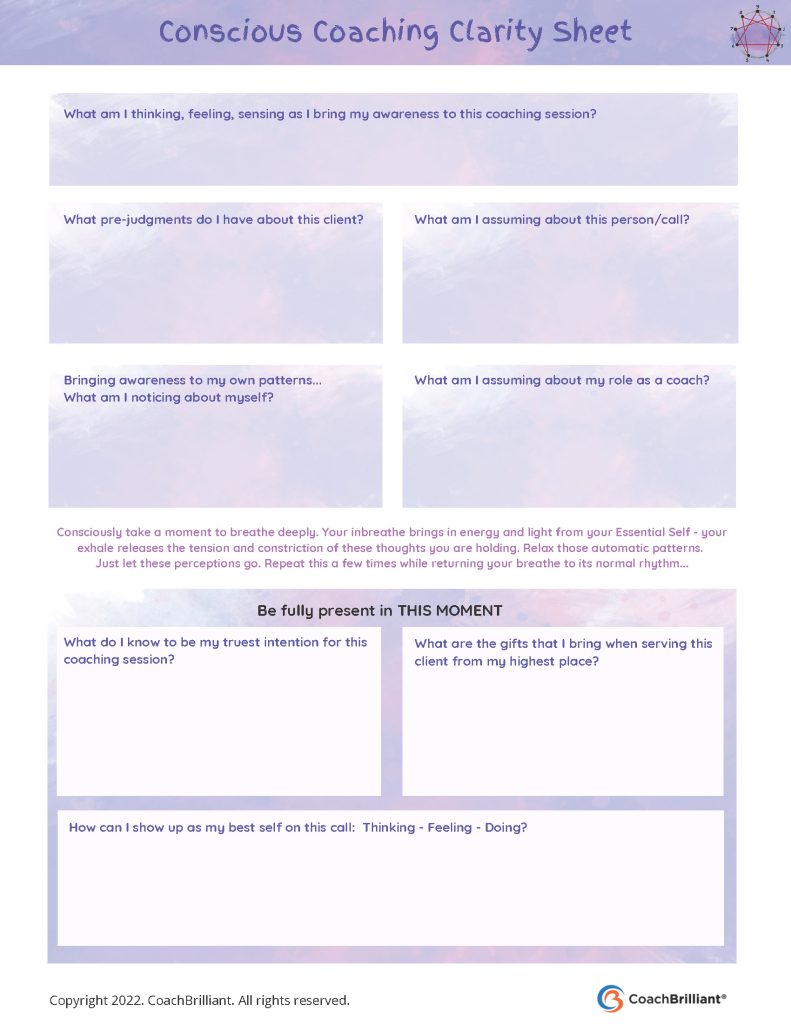
I created my own Conscious Coaching Clarity Process that I use to help me to release any stories I’m telling myself, release muscular tension and calm my own nervous system returning it to neutral so I can be fully attentive and focus 100% on my client.
This process helps me to reveal any triggers or constriction, interrupt the pattern by relaxing any constriction, and get grounded, present, and connected to my highest intention before any coaching call.
I do this naturally now, as part of my pre-coaching practice when I’m preparing to coach any client.
It’s important to get centered and grounded for every call. This is especially helpful if you find yourself feeling some emotional resistance or anxiety before a call:
- Maybe you’re not sure how to handle the conversation…
- Maybe you’re feeling triggered in some way and your defenses are up…
- Maybe you have a limiting belief showing up about your coaching capability…
I get quiet and still and consciously consider the following three steps to re-align me to my highest coaching self. It’s my way of shaking things off – just like my dog! It only takes a few minutes to complete…
Let me walk you through them:
The Conscious Coaching Clarity Process…
1. Notice what is currently going on for you…
Take a moment to tune into your own emotional reactions and bring them out of the shadow into your awareness. Become the observer – what is going on for you just now from each of these perspectives? Your internal reactions:
- The thoughts coming into your mind.
- The feelings you are having.
- The sensations you are having in your body. Where do you notice it in your body?
Unless you take a moment to be still, quiet, get back into your body and be fully present, you’ll be bringing your own to-do’s, dramas, challenges, and unconscious patterns into this coaching session.
Notice what comes up for you as you start to think about this client as you read their pre-coaching form. What thoughts, opinions, assumptions, judgments, concerns, resistance, and perhaps even emotions start to rise?
Questions to ask yourself:
- What am I thinking, feeling, and sensing as I bring my awareness to this coaching session?
- What pre-judgments do I have about this client?
- What am I assuming about this person/call?
- Bringing awareness to my own patterns… What am I noticing about myself?
- What am I assuming about my role as a coach?
2. Interrupt your patterns…
Take a few moments to step back be still and breathe… Your breath is such a powerful way to create a circuit breaker by interrupting the pattern, and coming back to your center.
It helps you to release the tension in your body, clear any gunk and return your breathing rhythm back to normal. Your breathing changes anytime you create tension. Take a moment to do this.
Questions to ask yourself:
- Notice your body posture, your breathing… Are you tense? Is your breathing shallower or faster? All these are indicators that you are caught up in your own patterns.
- Do a quick body scan from the top of your head to your toes. Do you notice any tightness or tension in your body? For example, do your shoulders feel tight or your toes are clenched?
- If so, slowly release that tight grip…let them loosen and relax. This is your way of shaking it off 🙂
3. Re anchor yourself to your truest intention.
You do this by grounding yourself and being fully present at this moment. I intentionally go back to my truest intention after the breathing exercise because it’s important to anchor back to my highest intention for this coaching session.
Questions to ask yourself:
- What do I know to be my truest intention for this coaching session?
- What are the gifts that I bring when serving this client from my highest place?
- How can I show up as my best self on this call: What am I Thinking, Feeling and how am I Acting?
Taking a few moments to complete this process before a call helps you to become aware of any patterns by bringing them out of the shadow and into our awareness. You create a gap between the situation and your reaction to it and you can see what is triggering you. These patterns aren’t the truth of who you are. Knowing this and letting go of your thoughts, helps you to interrupt the pattern and relax any constriction.You separate your own stories and emotional responses, letting go of any issues and assumptions you’d made about the person or the session.
Grounding yourself in this way ables to be fully objective and present at this moment. Returning your nervous system to neutral, enables you to intentionally anchor to your truest intention for this coaching session.
Preparing yourself like this before a call will help you to remain conscious and you’re attention will be focused on your client during the call. There’s less chance of you becoming triggered during the session because you have cleared the mental chatter, stories, assumptions and distractions that you would have otherwise dragged into your session.
As you follow this process, you’ll start to notice what happens as different clients show up. You’ll have different reactions to different things. Knowing yourself from this deeper place, helps you to stay in tune with your clients and clears the way for you to be the catalyst for supporting their self-exploration and transformational growth.
How do you shake off your thoughts, opinions, assumptions, judgments, concerns, resistance or triggers before any coaching conversation?
Are YOU ready to coach?
This advice also applies to leaders with preparing for coaching and feedback conversations.
Absolutely Lisa! Thanks for sharing this! It’s so easy for leaders to fall into the same reactive patterns, and this can have such a negative impact on their relationships with their staff.
Really fantastic, Elaine. This blog and your comments were very timely. Not for a coaching client, but regarding someone I am in a coaching practice group with.
Thanks so much for letting me know Glenda. Reach out if you’d like to jump on a call to talk about this some more – I’m happy to help 🙂
Wow, this is fantastic advice, I am not a coach, I am a 57 year old mum of three grown up children.
These days I over think every situation and decide how a conversation/meeting/situation is going to go long before I even meet the person.
Your advice is so good, thanks Elaine. I will definitely be shaking it out 😀
Thanks so much, Jane! I’m so glad this helped. You are so right, you don’t have to be a coach to use this, it works for everyone, as we can all get lost in our patterns of overthinking and projection. Here’s to shaking it out! 🙂