

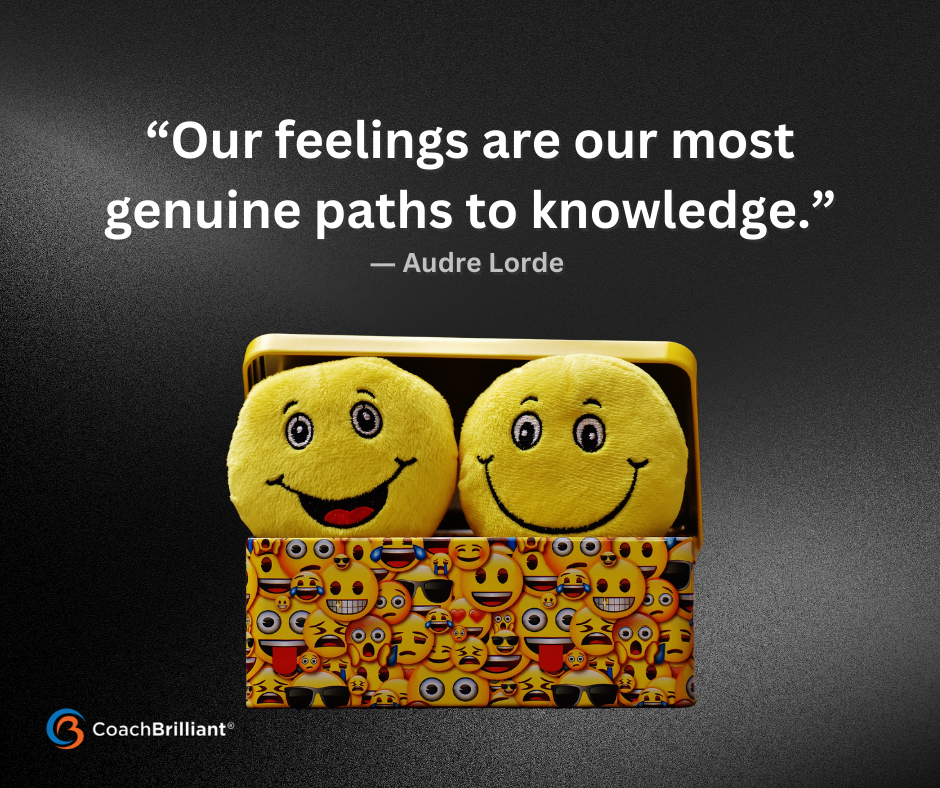
 Many of us are taught at an early age to repress our emotions. Showing emotions like anger, frustration, fear, and sadness are seen as weaknesses, so we quickly learn that they are unacceptable and stuff them down.
As we grow our elders teach us that our feelings are not to be trusted and there is definitely no place for feelings in the workplace. We’re taught to think because being smart is good. We learn to replace curiosity with fear, as we lose our sense of connection with our natural surroundings.
I’m working with a new client, who is learning how to coach. In a recent session, he came for coaching because he felt awkward and uncomfortable when his own clients got emotional or expressed their feelings.
He wasn’t sure how to handle other people’s emotions in a coaching context. He’d feel out of his depth to go deeper. The issue took up space and he didn’t feel equipped to deal with their emotions directly…
He admitted that inside he just wanted them to quickly regain their self-control and ‘get over it.’
Feeling uncomfortable, he’d react to the situation by overtalking, offering a box of tissues, and then saying anything to try and lighten the mood to get his client to stop being out of control.
Just STOP IT!
It’s funny how we label crying, anger, and even the expression of fear, as being out of control. It’s interesting to watch other people’s reactions when someone is crying.
Most people just want the other person to stop.
Unconsciously we might believe that maybe the pain will go away if you just push emotions like these away.
We have been taught to pull ourselves together, and not show our weaknesses, and we are encouraged to stop showing our emotions, especially at work.
Emotions are seen as sappy and weak: “Don’t wear your heart on your sleeve’, ‘Big boys/Girls don’t cry’, or ‘Don’t be a crybaby’.
From an early age, we’ve been conditioned to suppress any negative emotions. We’re taught to mask them even if we’re sad or depressed, when asked by someone else, we automatically say: ‘I’m okay.’
What many of us forget is that our emotions are there for a reason…
When we get upset (angry, scared, or tearful) we stop thinking. Our minds are designed to get our logic and thinking back online if an emotional circuit breaker kicks in. Expressing your feelings, e.g. talking your anger out with a friend on the phone, can be enough to restart your thinking.
Crying is a natural process to rid the body of pain and upset. It’s completely normal and is a healthy way to release the toxic energy that has built up inside us.
3 lies that we have been taught about our emotions:
- Crying increases the pain – So if you want it to stop – STOP crying!
- Being angry means that you’re out of control – Anger is a bad thing. No one should be angry EVER! Stop being angry and your anger will go away.
- Showing your emotions is a weakness – You need to toughen up and be more confident.
Stopping this natural release makes the pain find another route to flow. It is absorbed inside you, where it goes underground. Holding this in can cause pressure, anxiety, and even physical illness if the issue is held down long enough. These built-up feelings churn around inside you and block your thinking.
Here’s my response to my client who was struggling…
People cry for many reasons: frustration, sadness, or even because of a paradigm shift in their thinking that is having a profound impact on them.
At that moment, their emotions trigger a release of energy; they need to cry because in that moment they can’t think. It’s the same when we are angry, frustrated, or scared…
Hold space for this to happen for a few minutes. Let them be with the emotion.
In those few minutes, they don’t need your platitudes or smothering with words.
If they are angry – Let them just talk it out. All you have to do is listen. Don’t try to reason with them. Don’t jump in there and agree – you’ll make things worse! Ask them: What is it that is making you angry about this? What is underneath the anger?
If they are crying – Let them cry and just sit with them (don’t do anything!). They may cry because they are frustrated and unable to think. This will pass sooner rather than later if you don’t stop them.
If they are scared – Let them talk through their fear. Sometimes just articulating their fear and sharing it reduces its power. Again, all you have to do is listen.
Hold space for them – it’s perfectly okay and normal to feel these emotions. Help them to recognize their feeling and be willing to create a little space between themselves and their feeling.
Give the client your compassion, and sensitivity – slow things down. Help them to experience and be with their feelings. Staying with your feelings, rather than skipping over them helps the individual to process them fully.
Observe what happens…
They will recover in a short space of time and their thinking will re-engage. You don’t need to overcompensate by thinking for them and rambling out loud or grabbing the tissues, as an instant reaction.
Observe yourself…
Your job is not to make them STOP and instantly feel better. It is to be present and hold space for them to process. It’s okay…
It’s natural for people to occasionally get angry, cry or say that they are frightened. Allow a safe space for this to happen and you’ll observe how people can recover from their emotions and think more clearly afterward. Your emotions help you grow!
There’s truth in what Nancy Kline says:
“Crying can make you smarter.”
Next time you’re feeling angry, sad, or frightened, give yourself permission to be with your emotions. Allow them to pass through rather than internalizing and pushing them down.