

Over the past few weeks, two of my coaching clients have brought something familiar into our sessions – not a lack of motivation or clarity, but this quiet, frustrating feeling of inertia.
They want to take action. They care deeply about what they’re working on. But when the moment to begin arrives… they freeze, they scroll, they tidy the house – anything but the thing that actually matters.
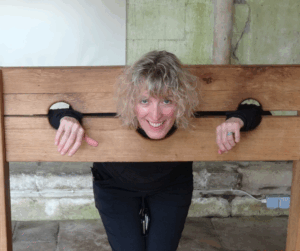
This is me… stuck in the stocks. Literally. It made me laugh, and it also hit a little too close to home. Because sometimes that’s what inertia feels like, isn’t it?
And honestly? I get it.
As a Type 7 on the Enneagram, I know a lot about staying busy, keeping the energy high, and jumping into new ideas. I’m naturally optimistic and future-focused. But inertia still sneaks in – just in a different way.
Inertia Isn’t Laziness – It’s a Signal
Inertia is so often misunderstood. It’s not about being lazy or unmotivated. It’s a protective response when something inside us feels unsure or overwhelmed.
It may appear after a significant transition. During burnout. Or in the middle of a creative season that feels more emotionally vulnerable than you expected.
For my clients, the pattern was clear: they could do everything, except the one thing that mattered most.
For me, especially after losing my home and everything I owned in Hurricane Helené, I discovered that inertia can hit even when you’re trying your hardest to keep moving.
As a Type 7, Inertia Doesn’t Look Like Stillness – Until It Does
One of the trickiest things about being a Seven is that we don’t always look stuck.
We’re moving, creating, starting new things, keeping the energy high – on the outside, it looks vibrant and exciting. But often, that movement is a way to avoid slowing down long enough to feel what’s really going on underneath.
After Helené, I wanted to stay busy. I thought movement would be my medicine – that if I just kept going, I could stay ahead of the pain.
But I couldn’t get moving. The trauma of losing everything held me in a vice-like grip.
I found myself just… sitting. Watching the trees. Staring at the walls. Frozen.
That’s when I realized that for Sevens, inertia often comes not from a lack of energy – but from being overwhelmed by emotion we’re not sure we can face. Grief. Vulnerability. Exhaustion. Fear of stillness.
And the only way through was to stop trying to outrun it – and start meeting myself where I was.
The Enneagram Shows Us How We Get Stuck – and How We Move
This is one of the reasons I bring the Enneagram into coaching – because it doesn’t just show us what we do; it reveals why.
Each Enneagram type has its own unique relationship to inertia, shaped by core motivations and patterns of avoidance:
Type 1 – The Reformer
Inertia shows up as over-planning or perfectionism. They may delay starting until everything is “just right,” fearing mistakes or not living up to their high internal standards.
Type 2 – The Helper
They often prioritize others’ needs so much that their own projects get sidelined. Inertia sets in when taking time for themselves feels unfamiliar or even selfish.
Type 3 – The Achiever
They may stay in constant motion – but avoid actions that might not lead to success or recognition. Inertia can come when deeper, slower work doesn’t have immediate results.
Type 4 – The Individualist
They may wait for emotional clarity or inspiration to strike. If the task feels flat or disconnected from their identity, inertia can take over.
Type 5 – The Investigator
They hold back until they feel fully prepared. Inertia often shows up as over-researching or conserving energy in the face of uncertainty or emotional risk.
Type 6 – The Loyalist
They may stall out from overthinking, doubting themselves, or worrying about all the things that might go wrong. Their inertia is often tangled with anxiety.
Type 7 – The Enthusiast
We often avoid discomfort by jumping to new ideas or over-scheduling. But when the fun fades or feelings get real, we can freeze, overwhelmed by the depth of what we’re trying not to feel.
Type 8 – The Challenger
They resist anything that feels vulnerable or slow. Inertia can show up when the task requires them to soften or surrender control.
Type 9 – The Peacemaker
Inertia is a central struggle. They can merge with others’ priorities, lose touch with their own direction, and avoid action to keep the peace – even within themselves.
Understanding your type won’t make inertia disappear, but it helps you meet it with far more clarity and compassion.
What Helped My Clients (and Me)
Neither of my clients needed more information or willpower. What helped was making things smaller and more gentle.
One committed to just opening the file she’d been avoiding – no pressure to finish. Another created a simple check-in routine with me: one sentence after showing up for herself.
I had to rebuild my rhythm slowly – not with rigid routines, but by creating little anchors in my day that reminded me I could begin again.
Some days, the win was just sitting outside with a notebook in my lap – not writing anything, but being willing to be present. That was enough.
If You’re Feeling Stuck Right Now…
Try asking yourself:
- What’s the smallest possible next step I can take – one that feels light and doable?
- What’s underneath the hesitation – is it fear, grief, pressure, or perfectionism?
- What does my Enneagram type need to feel supported?
- How can I show up for myself this week in a way that feels supportive, not punishing?
You don’t need to power through. You don’t need to leap.
You just need to start.
A Final Thought
Inertia isn’t a flaw. It’s feedback. It’s often a sign that you care deeply—and your system is asking for a slower, more compassionate way to move forward.
You don’t have to figure it out alone.
And you don’t have to push your way through.
This is the kind of thing we explore in coaching – not just productivity tips, but the real, human, emotional stuff that gets in the way when we’re trying to move forward.
If that’s where you are right now, I’d love to talk.
You’re not stuck – you’re just in a pause. And with a little support, you can absolutely begin again.
Thank you for sharing this information it really resonated with me as I am also feeling stuck and learning about my type’s inertia helped shed some light on what to be mindful of moving forward
Mikayla, Thanks so much for stopping by and reading. I’m glad it’s helped you shed a little light on what to be mindful of moving forward.
Thanks, Elaine. I loved reading this. Many of my decluttering clients get caught in inertia for many reasons – And I forget that one’s enneagram type is another clue. Of course, I also get caught there, and it reminds me to look at my own enneagram type as a tool for moving forward.
Thanks for letting me know, Joan. I’m glad you loved reading it. You must see a lot of inertia with decluttering clients, and I love that you are there to help them move forward through this. Thanks again, for stopping by 🙂