

 This question may seem a little strange…
After all, what equips coaches to work with clients are their natural gifts for helping others. Most coaches are relational, friendly, and approachable. Surely that’s important for building rapport and creating a great relationship?
So what do I mean by being too nice?
Nice is often the word clients use to describe a former coach when they are struggling to look for any good feedback to describe the coaching relationship. It’s usually followed by the sentence she/he didn’t really push me or challenge me enough.
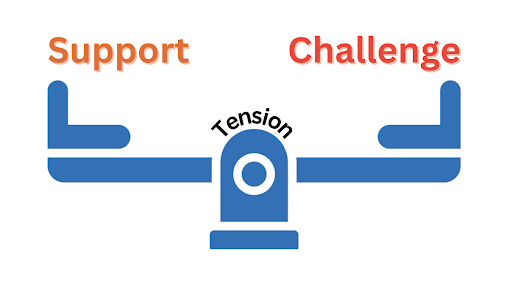
Nice coaches often avoid the sticky stuff and leave an unresolved issue flapping unattended in the breeze. It’s not their intention, but their focus is ONLY on supporting and NOT challenging and creating space for tension in order to help someone break through…
One friend recently described her former coach as:
“She was too nice – we had some great conversations and she is a lovely human being…(Long pause). Honestly, I came away feeling flat from some of our sessions because we hadn’t gone deeply into the issue. It was more of a comfy chat than coaching really, so I didn’t renew with her.”
I understood EXACTLY what she was talking about…
Many years ago I completed a research thesis for my Master’s Degree in Coaching and Mentoring Practice. I was honored to be asked to present my data and conclusions at Oxford Brookes University’s annual Research Conference in 2006.
My research findings highlighted one of the common reasons why coaching relationships fail: because the client wasn’t challenged enough. The data revealed that coaches in these situations were too friendly or nice and used their supportive behavior to avoid deeper issues.
Now, I’m an advocate for supportive coaching…
I agree that being supportive is important for building trust, and respect, developing rapport, and creating a safe environment to grow. This enables individuals to share their private thoughts and feelings and develop their self-awareness.
BUT…
Sometimes being supportive isn’t enough and you need to help your clients reach a deeper level of thinking that takes them out of their comfort zone, holds them accountable, makes them face those issues and roadblocks, and take risks to courageously achieve their goals.
Anytime this happens a client is going to feel more vulnerable. This is important to recognize.
A brilliant coach intuitively knows when to create the right amount of tension to challenge an individual beyond their current reality and patterns of thinking.
There has to be a balance between supporting and challenging…
Why do some coaches shy away from challenging their clients?
Some of us can feel uncomfortable when we have to hold a mirror up to a client to help them become aware of their own behavior and the impact of that behavior.
Of course, no one wants to hear that their own behavior is pushing customers away, stopping them from achieving their goals or having a negative effect on an important relationship.
(If you’ve ever received feedback, you know how tender and vulnerable you can feel in that moment.)
In these situations, your client might be triggered if they feel uncomfortable by the challenge and they might react negatively during the session. It’s a sensitive moment and one that can feel difficult for some coaches to handle.
Challenging a client can be more of a struggle if the coach is naturally wired as a People Pleaser or a Peacemaker because the last thing they want to do is upset, someone.
A coach may recognize the core issue and feel out of their depth to give feedback or challenge the client. They feel uncomfortable as the issue takes up space and is not dealt with directly or deeply.
If the coach allows their own unconscious patterns to get in the way of coaching, their behavior will hold the client back from creating the shift needed to help them break through.
Here are the common reasons why they don’t challenge:
- The coach doesn’t have the skills to go deeper and explore the issue
- The coach’s personality undermines and limits their coaching because they want to be liked
- The coach has not experienced how to do this for themselves in their own life experience, so they have no frame of reference.
How to create tension and challenge your clients over the edge of their comfort zone
Whether you coach people for performance as a leader in an organization or you run your own coaching business, you’ve probably learned to coach from a traditional supportive stance. Most coaching books heavily focus on this approach for success.
Sometimes being supportive isn’t enough and you need to help your clients reach a deeper level of thinking that takes them out of their comfort zone, holds them accountable, makes them face those issues and roadblocks, and take risks to courageously achieve their goals.
Great coaches intuitively know how to challenge and hold the tension until the pressure point is opened up and resolved.
It’s like when having a back massage, you feel the tension of the masseur applying some pressure to a specific point, then they hold exactly the right amount of tension waiting for those knotty bits to move (I’m sure there’s a technical term for this! 🙂).
It almost feels painful, but the relief of releasing those knots is worth all the discomfort!
It’s the same with deep coaching…
As a coach, you have to be okay with challenging and pushing self-awareness to a deeper level for your client.
You hold up the mirror and apply tension through observation and feedback, challenging them to be accountable, taking them out of their comfort zone into what Cranfield Business School calls the ZOUD (Zone Of Uncomfortable Debate) so you can get to the core of the issue and resolve it.
Applying and holding tension isn’t always pretty because you are creating discomfort. It might initially create a reaction of tears, anger, anxiety, guilt, fear, or shame, and your client may feel tense.
Intuitively you need to recognize this and apply your supportive coaching skills to re-create a balance, by tapping into their feelings, taking a breath, being with those feelings, and re-grouping before stepping back into the ZOUD and working through it together.
You have to believe that this will lead to a breakthrough for your client and provide positive supporting skills to face rather than avoiding the issue. This can be a challenge for you as the coach to stay with it, hold space and push deeper than before.
Help them to be with their emotions (resistance, anger, shame, etc.) and to process them fully. This will help you guide them to a deeper level of self-awareness and understanding.
Working through these knotty bits can take time, but the release of pressure and clearing the block can create huge transformational shifts for your client.
Staying stuck in a solely supportive style doesn’t deliver the full potential of coaching for your clients. Going deeper has a much greater impact on increasing self-awareness and creating better high-performance and successful outcomes.
I won’t hire a coach unless they demonstrate they can constantly challenge me to feel uncomfortable as I grow beyond my existing comfort levels.
If I can’t feel the discomfort, then I’m not growing!
This is why I’m investing my money in them. My future success depends on the level of my discomfort!
PLEASE keep pushing me over the edge of my comfort zone!
Are you challenging your coaching clients enough?